The AI Stack, from energy to intelligence experiences.
The modern AI economy is often misunderstood as simply “AI apps” sitting on top of large language models. In reality, AI is emerging as a full industrial and computational stack, where each layer enables the layer above it.
This framework places the BRAIN Platform Layer at the top of the stack, the Intelligence Operating System that abstracts model complexity and provides the shared capabilities every intelligent system needs. Below it sit applications, models, compute, and energy.
Five layers, one industrial system.
Read top to bottom: BRAIN orchestrates intelligence; applications make it visible; models provide the raw intelligence; compute provides the engine; energy is the foundation.
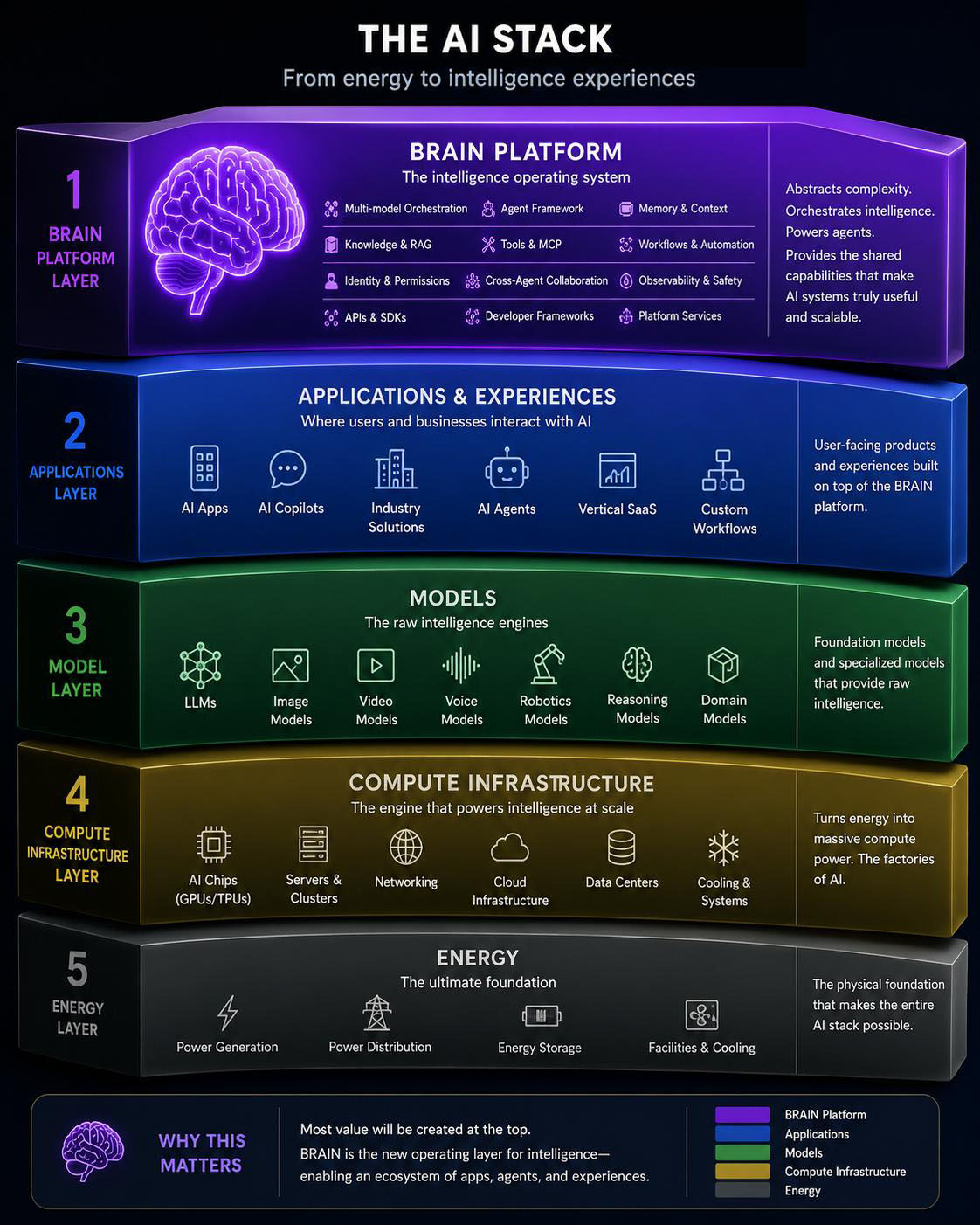
BRAIN Platform Layer
The Intelligence Operating System
The BRAIN Platform abstracts complexity and transforms raw AI models into reusable intelligent systems. It orchestrates intelligence, powers agents, and provides the shared capabilities that make AI systems truly useful and scalable.
Instead of every product rebuilding the same primitives, memory, identity, tool access, workflows, observability, BRAIN standardizes them once and exposes them to every application above it.
Core capabilities
Multi-Model Orchestration
Route tasks across models by capability, speed, cost, reasoning strength, modality, or reliability.
Agent Framework & Agents
Persistent AI agents that operate independently, maintain identity, carry memory, collaborate, and execute over time.
Memory & Context
Short-term context, account-level memory, and ecosystem-level memory that compounds across users and platforms.
Knowledge & RAG
Vector databases, document ingestion, retrieval, and organizational knowledge as a shared substrate.
Tools & MCP
Function calling, MCP, external APIs, databases, CRMs, communication platforms, and automation pipelines.
Workflows & Automation
Decision trees, autonomous workflows, event handling, approvals, escalations, and cross-system execution.
Identity & Permissions
Access control, tenant separation, identity, permissions, audit, governance, and security.
Cross-Agent Collaboration
Agent-to-agent protocols and shared state so independent agents can coordinate without rebuilding the substrate.
APIs & SDKs
Programmable surface for building apps, copilots, vertical SaaS, marketplaces, and digital workers.
Developer Frameworks
Opinionated patterns, libraries, and scaffolding for building agentic products quickly.
Observability & Safety
Tracing, evaluation, guardrails, audit log, and runtime safety for AI systems in production.
Platform Services
Billing, analytics, deployment, infra primitives that every intelligent system reuses.
Purpose
Provides the shared intelligence layer that powers applications, ecosystems, and future agent-native platforms. The most valuable companies of the AI era may not simply build applications or models, they may own the intelligence operating layer that orchestrates, coordinates, and amplifies entire ecosystems of intelligent products.
Applications & Experiences
Where users and businesses interact with AI
This is the layer where intelligence becomes visible and useful. User-facing products and experiences built on top of the BRAIN Platform, copilots, consumer apps, industry solutions, vertical SaaS, and custom workflows.
Because the heavy intelligence infrastructure has already been abstracted by the layer above, applications focus on user experience, workflows, industry specialization, branding, and distribution. They consume capability from BRAIN rather than rebuilding it.
- ●AI Applications
- ●AI Copilots
- ●Industry Solutions
- ●Vertical SaaS Platforms
- ●Custom Workflows
Model Layer
The raw intelligence engines
Foundation and specialized models that provide raw intelligence across multiple modalities. Reasoning, generation, prediction, classification, and multimodal understanding.
Raw models alone are not enough. Models are fragmented, lack persistent memory, do not naturally collaborate, have limited business context, and cannot independently orchestrate workflows. They are intelligence in isolation, until the layer above turns them into systems.
- ●Large Language Models (LLMs)
- ●Image Models
- ●Video Models
- ●Voice Models
- ●Robotics Models
- ●Reasoning Models
- ●Domain-Specific Models
Compute Infrastructure Layer
The engine that powers intelligence at scale
Transforms energy into usable computation. This is the industrial machinery of AI, digital factories for intelligence that process massive amounts of data and run increasingly sophisticated models at global scale.
Capital intensive, technically complex, and increasingly strategic at geopolitical scale. Companies operating here build the infrastructure backbone that powers the entire AI economy.
- ●AI Chips (GPUs, TPUs, NPUs)
- ●Servers & Compute Clusters
- ●Networking
- ●Cloud Infrastructure
- ●Data Centers
- ●Cooling Systems
Energy Layer
The ultimate foundation
The physical foundation that makes the entire AI stack possible. AI is fundamentally a power-intensive industrial system. Every prompt, model inference, video generation, robotic action, and autonomous workflow ultimately consumes electricity.
As AI scales globally, energy becomes one of the most strategic resources in technology. Without abundant, reliable, and scalable energy, none of the layers above can exist.
- ●Power Generation
- ●Power Distribution
- ●Energy Storage
- ●Facilities & Cooling
Value compounds as you move up the stack.
Every layer builds on the one beneath it. Energy enables Compute Infrastructure. Compute Infrastructure enables Models. Models enable the BRAIN Platform. The BRAIN Platform enables Applications and Experiences.
The most valuable companies of the AI era may not simply build applications or models, they may own the intelligence operating layer that orchestrates, coordinates, and amplifies entire ecosystems of agent-native products.
BRAIN is the Intelligence Operating System.
BRAIN sits at the top of the AI stack, abstracting model complexity while providing the common capabilities every intelligent system needs:
- ●Agentic Frameworks
- ●Memory
- ●Knowledge
- ●Workflows
- ●Automation
- ●Identity
- ●Collaboration
- ●Tool Access
- ●Platform Services
As AI matures, value is expected to consolidate around the platforms that connect and amplify intelligence across many applications, rather than within a single application itself.